Microsoft Teams Direct Routing: Everything Canadian Organizations Need to Know
Isabelle Brunner
Direct Routing
Turning Microsoft Teams into a secure, flexible, and cost‑effective phone system is now a priority for Canadian organizations, navigating hybrid work, rising telecom costs, and strict sovereignty requirements. Direct Routing is the fastest, most compliant way to get there.
Why Direct Routing Matters Now
Most Canadian organizations already use Teams for collaboration, but many still rely on aging PBX systems for external calling. These legacy systems weren’t built for hybrid work, modern security expectations, or today’s cost pressures.
Direct Routing closes that gap by transforming Teams into a full cloud phone system while giving organizations carrier choice, Canadian hosting, and full control over call quality and routing.
What Direct Routing Actually Is
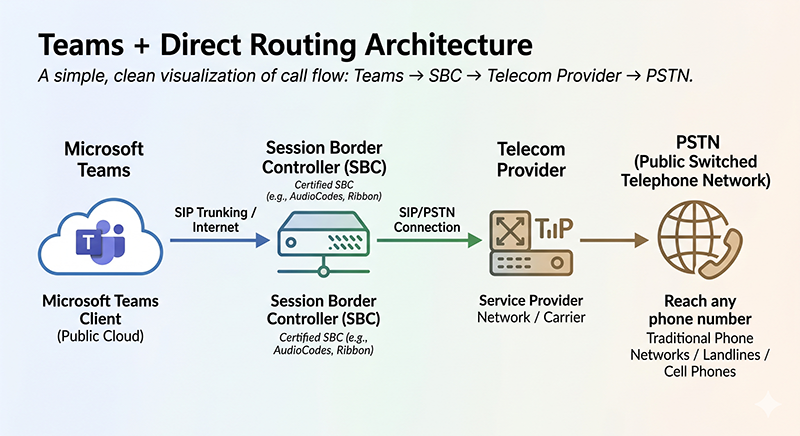
Direct Routing connects Microsoft Teams to the PSTN through a certified Session Border Controller (SBC) and a telecom provider. This allows Teams users to make and receive external calls just like a traditional business phone system. It’s a simple concept with a powerful impact: Teams becomes the single platform for meetings, chat, collaboration, and now, enterprise voice.
How It Works
The architecture is straightforward:Teams → SBC → Telecom Provider → PSTNdirect routing architectureThe SBC acts as a secure gateway, managing and encrypting voice traffic. The telecom provider delivers SIP trunking and PSTN connectivity. Together, they give organizations:
The freedom to choose their carrier
Customize call flows
Maintain Canadian‑hosted voice infrastructure
Full control over routing and quality
Why Canadian Organizations Are Moving to Direct Routing
Direct Routing offers a combination of flexibility, cost efficiency, and compliance that aligns with the needs of Canadian organizations, especially those operating in regulated sectors.Direct Routing aligns with the needs of Canadian organizations that require:
Lower telecom costs
Elimination of PBX hardware
Custom call flows and auto attendants
Consistent calling across devices
Canadian data residency and sovereignty
Most importantly, Direct Routing can be deployed using Canadian‑hosted SBCs, supporting data residency and sovereignty requirements across healthcare, government, education, and finance.
Direct Routing vs. Microsoft Calling Plans
Direct Routing
Microsoft Calling Plans
Cost
Lower, flexible
Higher, fixed
Customization
Advanced
Basic
Carrier choice
Yes
No
Compliance
Can be fully Canadian
Region-dependent
Scalability
High
Moderate
Analytics
Enhanced with Telecom Metric
Limited
For organizations that need sovereignty, cost control, or advanced routing, Direct Routing is the clear fit.
Ideal for Regulated Canadian Industries
Direct Routing aligns naturally with the compliance requirements of:
Healthcare (PHIPA)
Government (data sovereignty)
Education (secure communication for staff and students)
Finance (auditability and security controls)
Encrypted voice, redundant Canadian data centres, and customizable routing policies make it a strong fit for organizations that cannot compromise on security or sovereignty.
Where Telecom Metric Adds Value
Direct Routing is powerful on its own, but Telecom Metric turns it into a fully observable, data‑driven voice ecosystem.
Direct Routing is powerful: Telecom Metric makes it fully observable and data‑driven.
Real‑time call quality monitoring
Proactive alerts to detect issues before users notice
Usage insights to optimize cost and capacity
Hybrid work diagnostics for remote performance
Migration analytics for smooth PBX → Teams transitions
Telecom Metric gives IT leaders the intelligence to optimize, troubleshoot, and scale Direct Routing with precision.
A Smarter Path to Modern Communication
Direct Routing isn’t just a technical upgrade… it’s a strategic shift toward unified, secure, and sovereign communication.Work with a Canadian provider to build a secure, compliant Direct Routing setup enhanced by Telecom Metric’s real‑time insights.